Cutting Notes · 2026.07 · 14 min read
A Building That Walks
Notes on the concealed architecture of trousers: how waist position, fork geometry, pleats, cloth, and hem length bring movement into balance.
Share / 分享
Ready
Notes on the concealed architecture of trousers
Every tailoring house reserves its most conspicuous artistry for the garments above the waist. The jacket is the principal site of construction: a floating canvas, hand-padded lapels, and shoulders shaped for a particular wearer. Trousers contain far less concealed structure. Beyond a reinforced waistband, pocketing, and partial lining, there is little more than cloth, seams, and the continuous action of gravity.
Tailors often observe that trousers are more difficult to cut well than jackets. The reason becomes apparent on close examination. A jacket can be engineered to retain a prescribed form; trousers depend more directly on balance. Their silhouette is continuously determined by the weight of the cloth, the geometry of the pattern, and the movement of the body. The task resembles designing a building that must move, an architecture whose foundations change position several thousand times each day. Every decision that follows, from the height of the waistband to the final length of the hem, addresses that condition.
The waist as a lock
The first question is where the trousers should sit, because every subsequent measurement begins there. The natural waist usually lies near the narrowest part of the torso, between the lower ribs and the upper edge of the pelvis. Wearing trousers at this level is not merely a stylistic convention; it offers a mechanical advantage. The inward curve provides a stable position for the waistband, with little opportunity for it to descend. Gravity acts on the garment and movement draws on the legs, yet the waistband remains comparatively secure.
When the waistband is lowered, as it is in much ready-to-wear, its point of support moves onto the convex surface of the pelvis. This position is less stable. The waistband is more likely to descend, the shirt to pull free, and excess cloth to collect around the crotch. Proportion is also affected. A higher rise can establish a continuous visual line from the torso to the shoe, while a lower rise divides the figure near its widest point and makes the upper body appear longer.
Even at the natural waist, the waistband requires adjustment. Its rear section follows the relatively even curve of the lower back; the front must accommodate the abdomen. If it is placed across the fullest point, the abdomen can exert continual downward pressure. The cutter may therefore set the waistband level above the fullness or incline it towards a lower position at the front. The correct balance is established during fitting, through observation of the wearer's posture and the changes between standing and sitting.
The method of support determines how the weight of the trousers is carried. Braces provide the most direct solution. They suspend the garment from the shoulders, so the waistband does not need to grip the body. It can therefore include sufficient ease for comfort throughout the day, while the cloth below hangs under its own weight. The disadvantages are practical: an additional garment to put on, another layer in warm weather, and the general need to keep the jacket in place. Side adjusters offer a less visible compromise. They concentrate adjustment at the sides above the hip bones and preserve an uninterrupted front. When integrated into an extended waistband, they can also reinforce the stability of a higher rise. A belt operates differently, applying compression around the entire circumference. Any excess ease is gathered into folds, while the belt introduces a strong horizontal division across a garment intended to establish a vertical line. For this reason, bespoke trousers are often made without belt loops, although belts remain appropriate to denim and substantial cotton cloths.
Cloth in motion
During a full stride, the circumference of the thigh increases. Cutters account for this as the walking thigh. The necessary allowance is provided principally through the fork extension of the pattern, especially at the rear. Adequate rear fork extension allows the advancing thigh to move without pulling the seat or displacing the front crease. If the extension is insufficient, the cloth is drawn tightly across the seat, the rear waistband is pulled down, and diagonal strain lines travel from the inner thigh across the front of the leg. These lines are common in ready-to-wear trousers and indicate that the pattern has not provided enough room for movement.
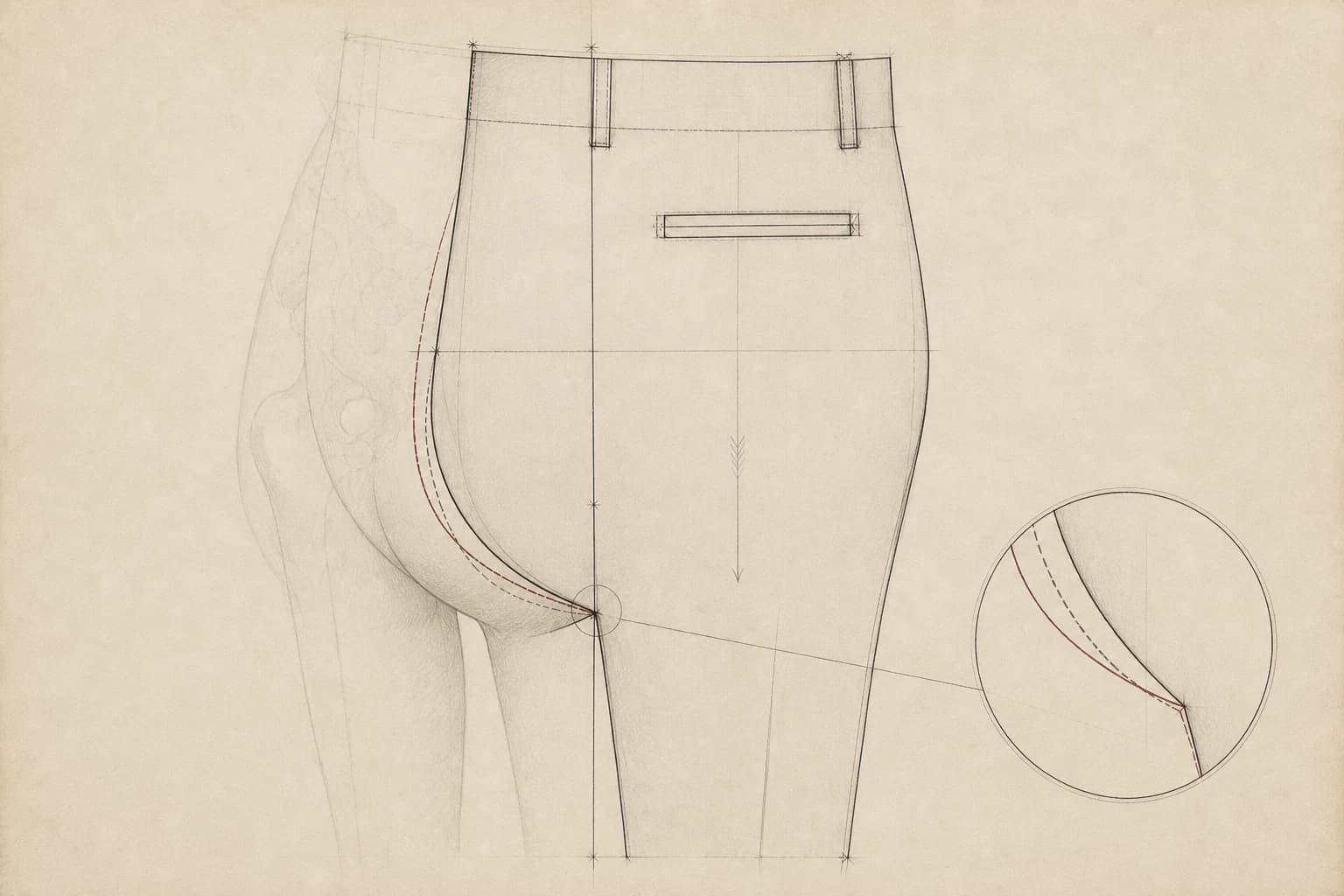
Below the seat lies one of the most sensitive parts of the draft: the rear crotch curve, which connects the waistband to the fork. Its shape must be considered together with the angle of the seat and the length of the fork extension. A fuller seat may require additional depth or extension where the cloth would otherwise bind and rise. A flatter seat may require less length and fullness to prevent horizontal folds beneath the buttocks. There is no universal alteration. The correct solution is a curve and balance matched to the individual figure, and a change of one centimetre in this concealed area can materially alter the entire silhouette.
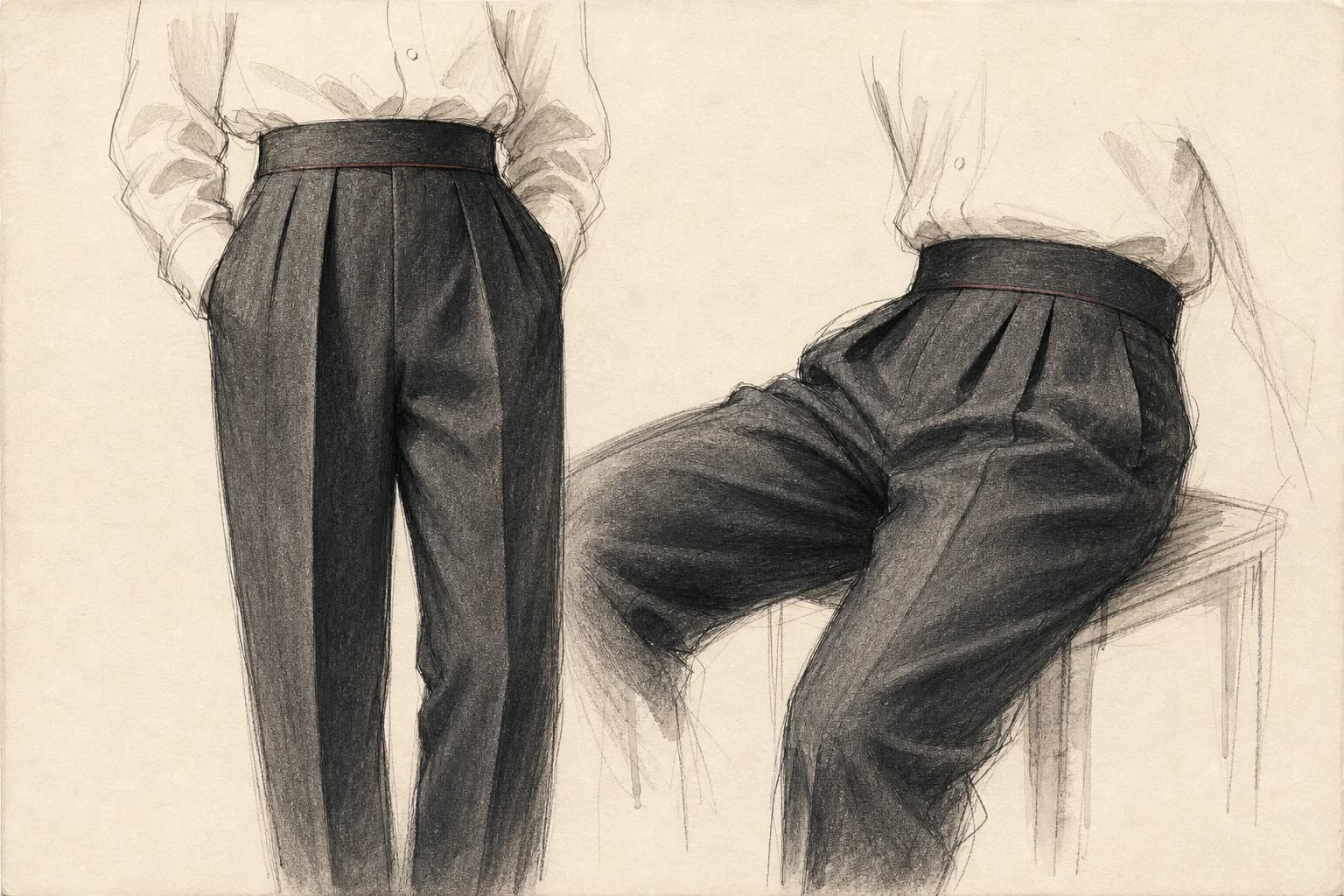
Sitting places the greatest demand on the pattern. The pelvis rotates backwards, the seat broadens, and the trousers must provide additional circumference. This is one of the principal functions of a pleat. A well-cut pleat holds a reserve of width. It remains closed when the wearer is standing, opens under the greater demand of a seated position, and returns when the wearer rises. A pleat that remains open on a standing figure may indicate insufficient ease through the hips or an imbalance elsewhere in the pattern. It should therefore be treated as a fitting question rather than assumed to be a stylistic effect.
Two traditions, five millimetres apart
The direction of a pleat may appear to be a minor detail, yet two major tailoring traditions have historically approached it differently.
London tailoring has often favoured the forward pleat, which folds inwards towards the fly. The English suit frequently seeks to regulate the silhouette rather than reproduce the body exactly, and the forward pleat contributes to that purpose. Its inward fold directs fullness towards the centre and places the weight of the cloth above the front crease. In combination with a fuller English trouser leg, the result is a more columnar form. The trousers maintain an independent line rather than closely describing the leg within them.
Neapolitan tailoring has more often used the reverse pleat, which folds outwards towards the pockets. Its objective is generally different. The Neapolitan ideal of sprezzatura favours clothing that sits lightly on the body. By distributing fullness across the hip, the reverse pleat reduces the visual dominance of the crease and permits a softer transition through the upper leg. These associations are conventions rather than rules. Savile Row cutters also make reverse pleats, and Neapolitan cutters make forward pleats. Nevertheless, the persistence of each preference reflects a broader distinction: one tradition tends to impose order on the figure, while the other tends to accommodate its movement.
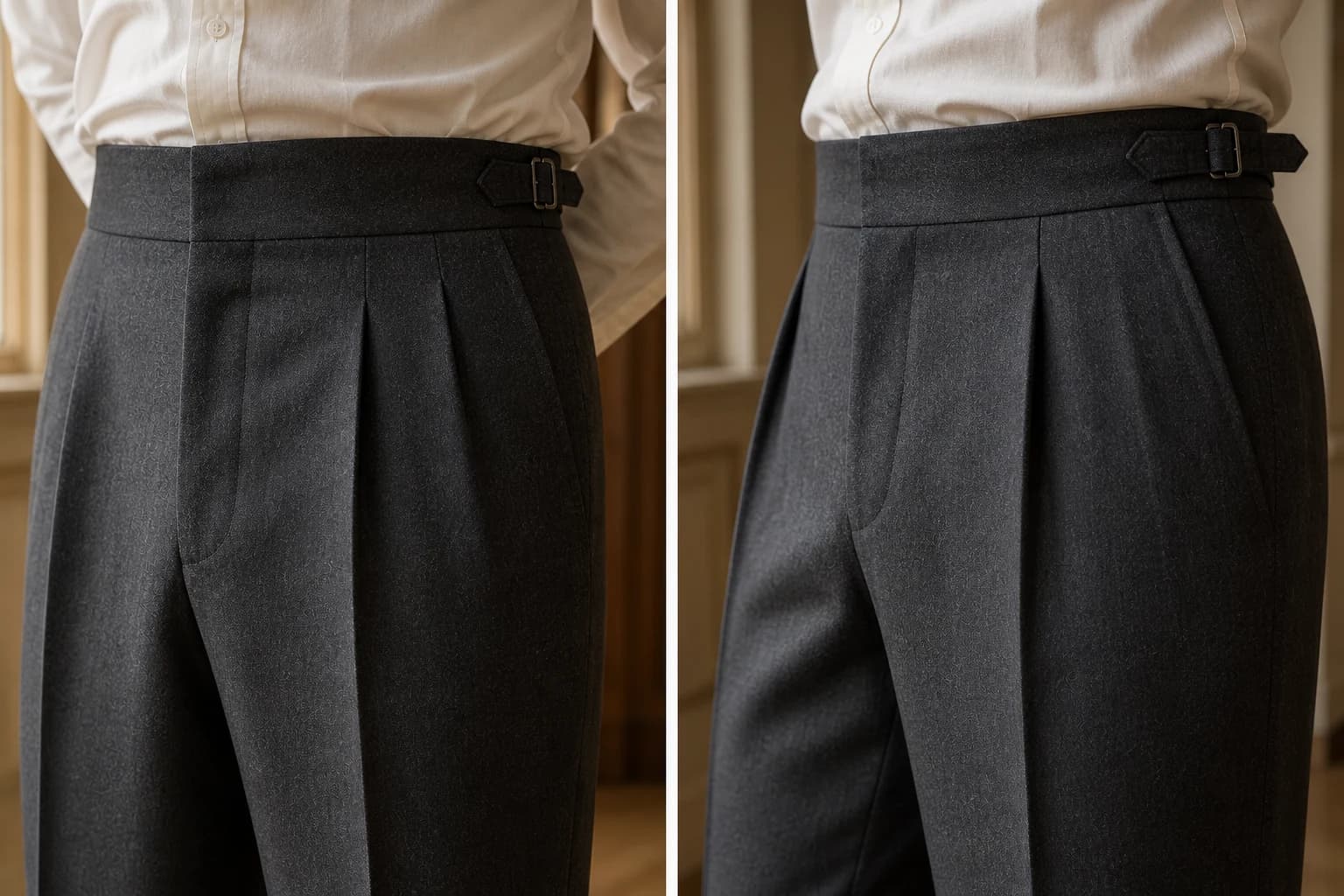
The difference extends beyond the visible fold. A wider English leg allows the rear seam to rise on a comparatively vertical line. When the thigh is narrowed, as it often is in Neapolitan trousers, the pattern must extend farther beneath the seat, and the rear seam assumes a more pronounced diagonal. The finished measurements can remain remarkably close. When the menswear writer Simon Crompton compared an English pair by Whitcomb & Shaftesbury with a Neapolitan pair by Cerrato, the flat widths at the knee and thigh differed by only half a centimetre, while the Cerrato trousers narrowed more sharply below the seat. Five millimetres can therefore express a substantial difference in cutting philosophy.
The physics of drape
Even carefully judged geometry can be undermined by an unsuitable cloth. Drape is partly measurable. Textile engineers can quantify resistance to bending and shear, and these properties, together with weight, yarn construction, weave, and finishing, influence the way a cloth falls. No single measurement describes drape completely, and weight alone does not determine it. Nevertheless, cutters frequently recommend heavier cloth for trousers because greater mass strengthens the effect of gravity and helps the garment recover a clear vertical line.
Woollen flannel provides a useful example. A traditional flannel of thirteen to fifteen ounces is woven from carded woollen yarn and milled until the fibres form a dense, softly raised surface. At this weight, the cloth falls with continuity and authority. Creasing behind the knee relaxes more readily after the wearer stands, and heat, moisture, and pressure allow the wool to accept and retain a defined crease. When the weight falls substantially below approximately eleven ounces, these advantages become less pronounced: the knees deform more readily and the crease loses definition sooner. Experienced cutters and wearers therefore often favour the heavier option when durability of line is important.
In summer, lower weight is necessary and a different set of properties becomes valuable. An ordinary worsted of eight or nine ounces may breathe well but lack sufficient mass to fall cleanly, and it can retain wrinkles after prolonged sitting. High-twist cloth provides an alternative. Increasing the twist of the yarn contributes resilience and helps the cloth recover its shape. Fresco, recognised by its dry and slightly open handle, is a well-known example. After compression in a seated position, a high-twist cloth can recover much of its surface by the time the wearer is standing and moving again. Flannel achieves stability principally through mass; high-twist cloth achieves it principally through resilience. Together they provide complementary solutions for different seasons.
Where the line meets the shoe
The final variable is length, and it is better understood as a relationship than as an isolated measurement. A generously cut leg with an opening of nine or ten inches measured flat, approximately twenty-three to twenty-five centimetres, can lose stability when it is finished short of the shoe. The wide hem moves with each step, and the front crease can curve outwards near the bottom. A narrow leg in a crisp cloth, by contrast, may remain clear of the shoe without disturbing the line.
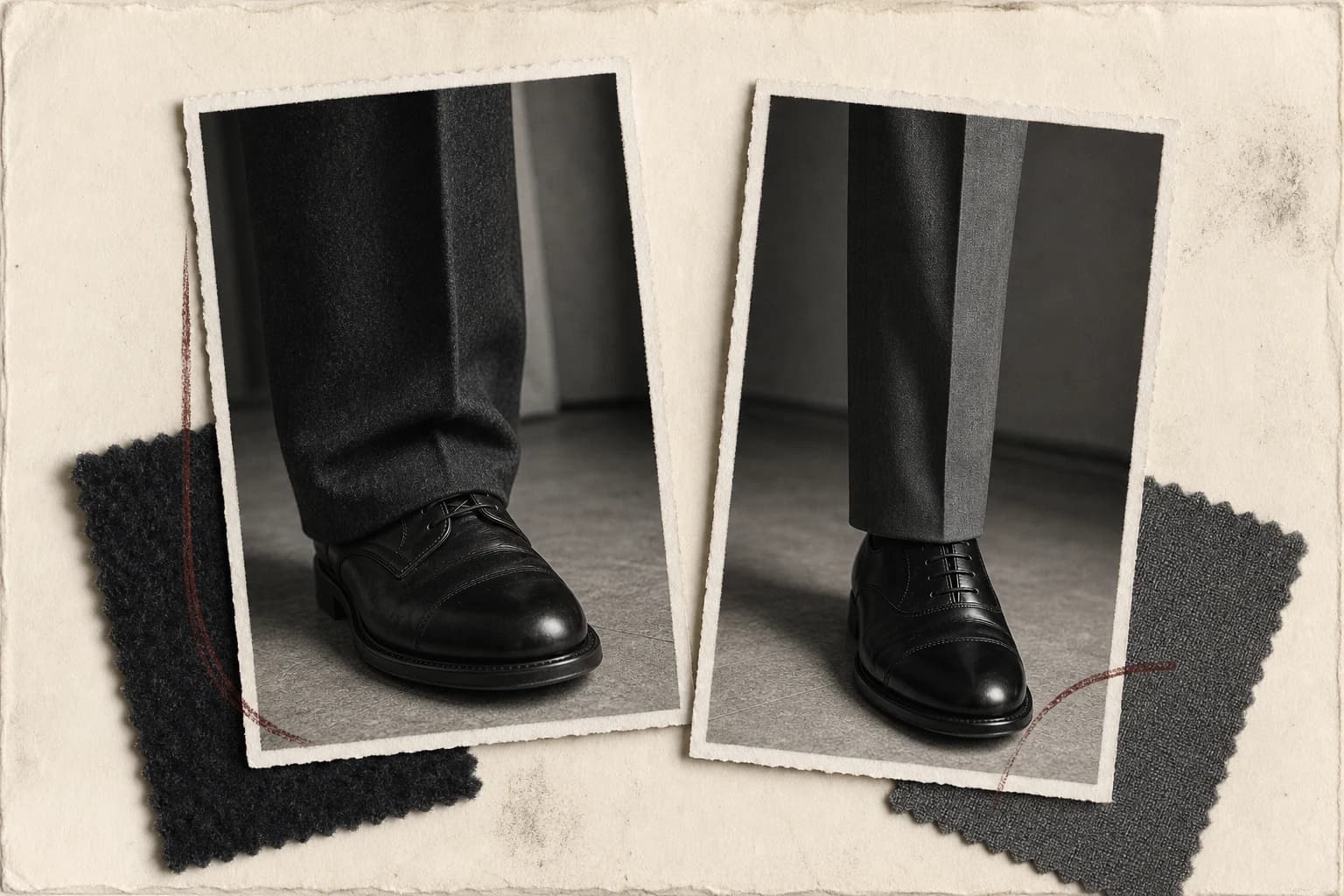
For a wider leg, an additional inch, approximately two and a half centimetres, can produce a different result. When the hem just meets the vamp, this slight contact reduces movement and maintains a continuous crease from the waistband towards the shoe. The Los Angeles menswear writer Ethan Wong, for many years an advocate of clean hems without a break, documented this effect as his own trousers became wider. The additional length and its modest weight helped the crease remain directed forward and allowed the shoe to act as the visual anchor of the garment. His example is valuable because it illustrates a conditional relationship rather than a universal rule. Trouser length depends on four variables: the width of the opening, the weight and character of the cloth, the form of the shoe, and the line desired by the wearer. A change in any one of them can alter the appropriate length.
When this relationship is correctly resolved, the structure becomes coherent: the stable waist, the allowance for movement at the fork, the controlled expansion of the pleats, and the weight or resilience of the cloth all conclude at a secure visual foundation.
A jacket can reshape the figure through canvas and padding. Trousers permit less concealment. Their success depends on judgment, geometry, and gravity being brought into balance with sufficient precision that the wearer does not need to consider them. At the end of a day of walking, sitting, and rising, there should have been no persistent pulling, no downward movement at the waist, and no loss of direction in the crease.
Atelier Saison
Bring movement into the fitting
Well-cut trousers begin with how a body stands, sits, and walks. The waist, fork, pleat, cloth, and hem are balanced together rather than chosen in isolation.
一条好裤子始于身体如何站立、落座与行走。腰位、裆叉、裤褶、面料与裤脚,需要在试身中一同取得平衡。